Pickleball Doubles Strategy The Complete Guide for 3.5–4.5 Players
Positioning, kitchen control, third-shot decisions, partner movement, targeting, and the mental frameworks that separate players who react from players who decide.
The Design Is the Strategy
Pickleball was not invented as a slower version of tennis. It was designed from scratch — a smaller court, a perforated ball, a paddle with no strings. Those design choices are not cosmetic. They are strategic. They throttle pace, compress movement, and reward positioning over power. Understanding this is where doubles strategy begins.
The non-volley zone — the kitchen — exists precisely to prevent the overhead smash that dominates tennis. It forces every player to earn their attack from a controlled position. The player who understands this stops trying to generate pace and starts trying to earn the right ball. That shift in thinking changes everything.
The Kitchen Is the High Ground
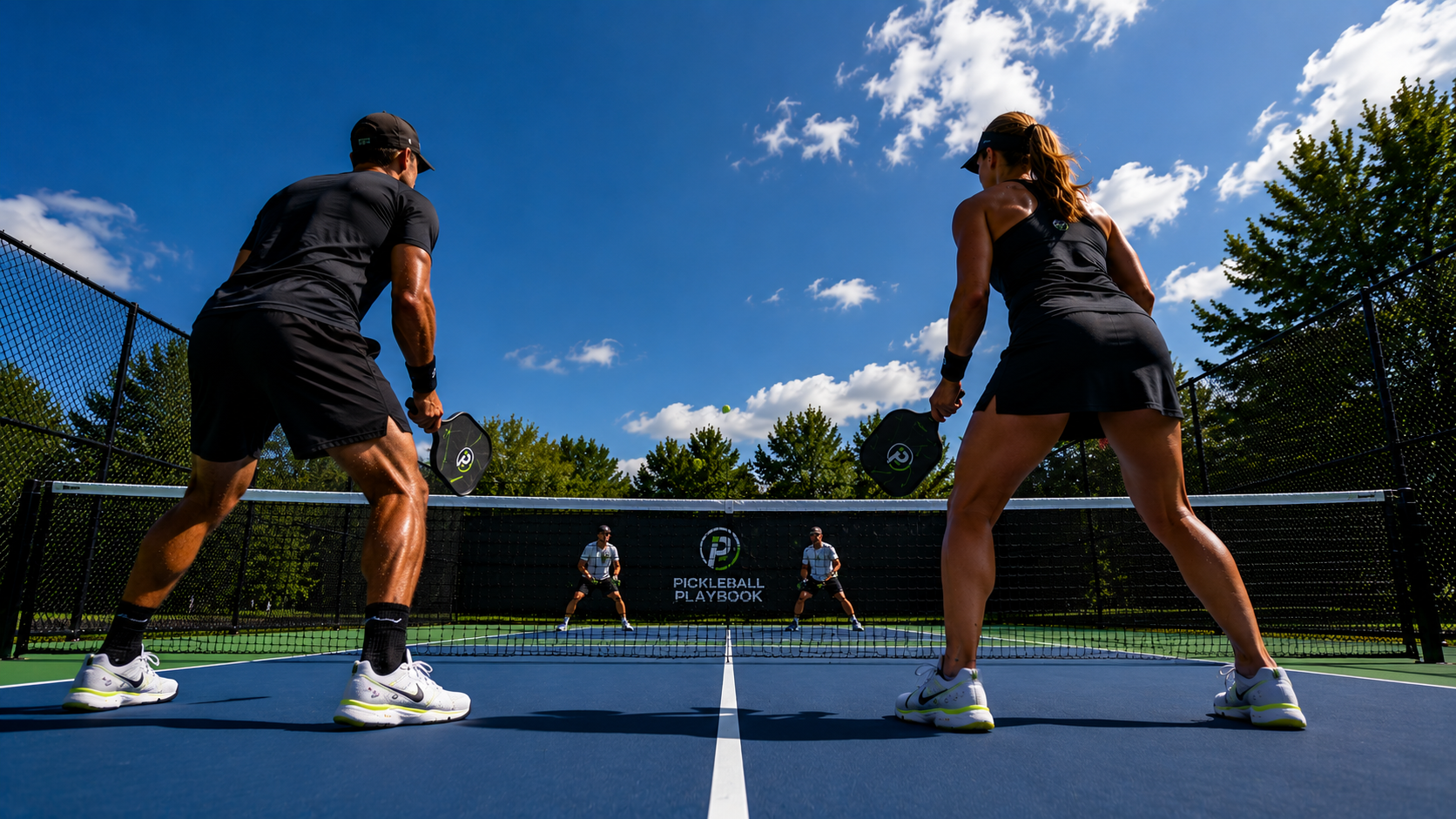
All positioning strategy in pickleball doubles begins with one question: who owns the kitchen? The team at the Non-Volley Zone line has angle advantage, contact-height advantage, and tempo advantage. The team in the transition zone is always hitting upward, always defending.
Think of it as two armies — one on a hill, one on the plain below. The team at the kitchen looks down on every exchange. The team at the baseline or in transition is always working harder just to stay in the point. Your serve, your return, your third shot — every shot in a rally is in service of one goal: getting both players to the kitchen line together.
Balanced arrival is everything. Reaching the kitchen means nothing if you arrive mid-stride. Stop, split-step, then play. And both players must arrive together — one player at the kitchen while the partner is still in transition is half a team at the high ground.
Own the Donut — Court Coverage at the Kitchen
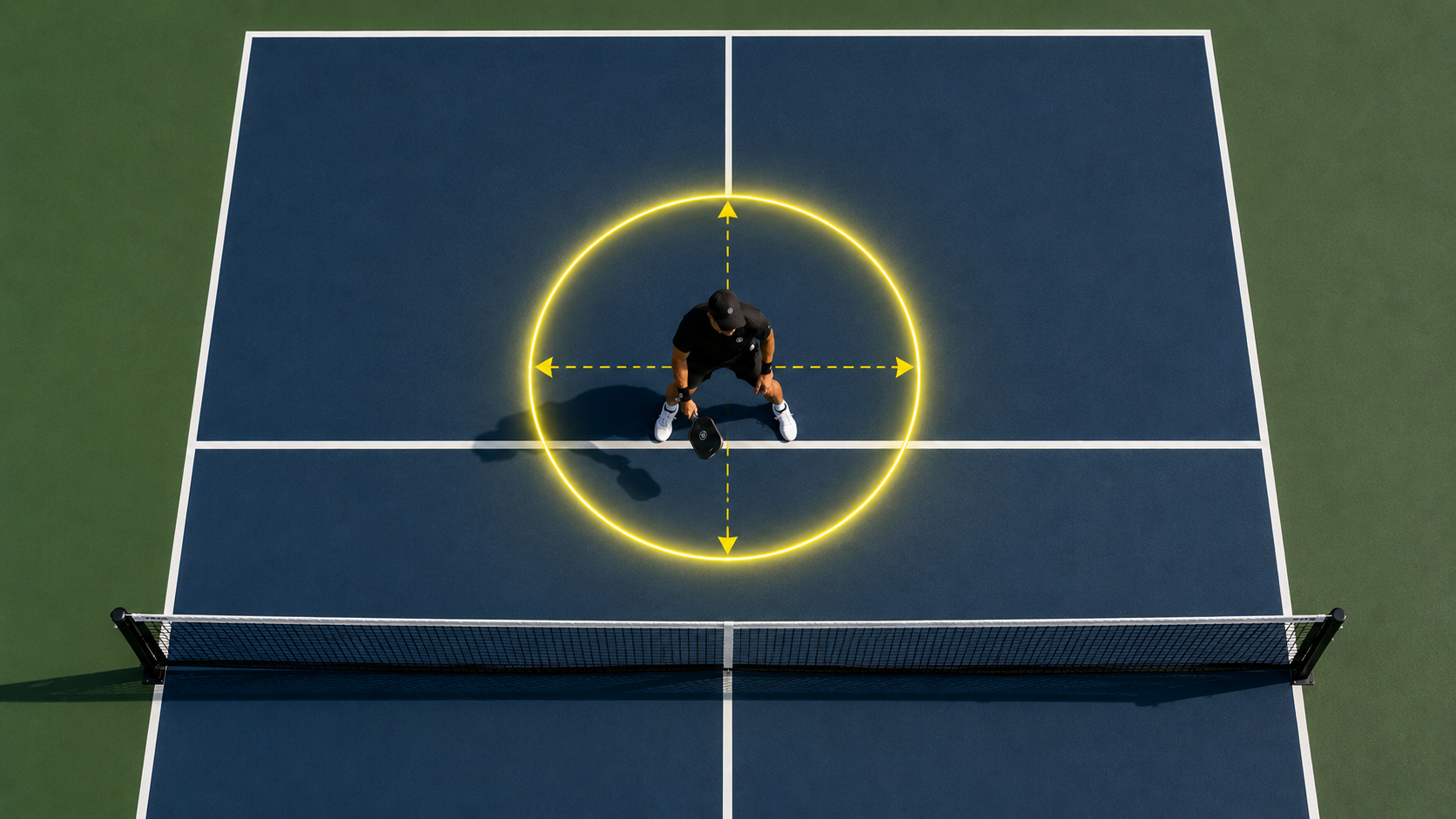
Pickleball movement at the kitchen line is radically compressed compared to other court sports. In tennis, basketball, or soccer, covering ground is the game. In pickleball, the movement vocabulary is smaller — and understanding that early prevents the most common and costly error at the kitchen: over-moving.
Each player owns a Donut — a circle of space roughly one step in any direction from their position. Forward, sideways, back — and always return to center. The Donut is small. Own it completely. Return to its center after every single shot.
A player who steps and does not recover has abandoned their Donut. Over time this opens gaps, shifts the partner's coverage, and creates the exact seams opponents will exploit. The discipline of staying compact — moving only when necessary, then recovering to center — must be actively trained against athletic instinct.
The Dink — Offense with Patience
The dink is not a passive shot. At the highest level of doubles, the dink is the primary offensive tool — a weapon that creates the precise conditions needed to attack. Not hitting harder. Not moving faster. Creating the right ball by controlling the situation.
A well-placed dink that dies in the kitchen forces the opponent to hit upward, producing a floated ball that rises into the attack zone. That is offense with patience — the deliberate creation of a green-light ball through strategic restraint.
The dinking exchange is not waiting. It is chess. Every dink is aimed — at the backhand hip, at the feet of a moving player, at the partner who is off-balance. The player who understands this stops surviving dink rallies and starts winning them.
The apex of a well-executed dink should be on your side of the net — before the ball crosses. When the ball peaks on the hitter's side and descends across the net, it arrives in the kitchen on a falling arc. A descending ball lands shorter, dies faster, and sits lower — giving the opponent no upward angle to attack from. A dink that peaks over or past the net arrives flatter or still rising, sitting up and inviting a speed-up. The discipline is not just clearing the net — it is peaking before it.
The Traffic Light — When to Attack
The single most common mistake in intermediate doubles pickleball is attacking the wrong ball. A fast swing at a low ball produces a net cord or an easy pop-up for the opponent. Learning when to attack — and when not to — is the difference between a 3.5 player and a 4.0 player.
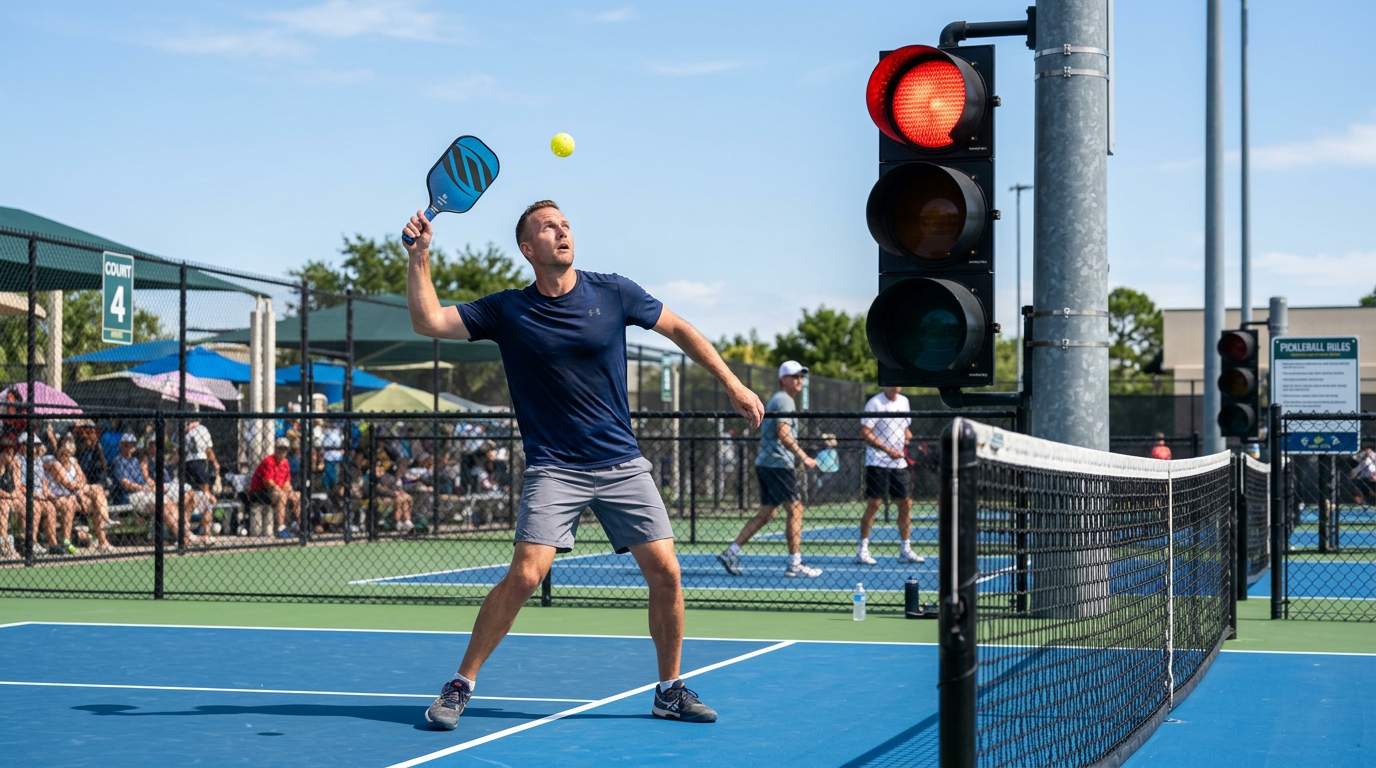
The Traffic Light is a contact-height decision rule:
Yellow — Pressure: Ball arriving at mid-thigh. Apply pressure — a firm, directed shot — but do not go for the finish.
Red — Reset: Ball below the knee. Soft hands. Dink or drop it back into the kitchen. Do not attack this ball.
The Traffic Light is retrievable mid-point in less than a second. No reasoning required. When the ball arrives, the light is already on. That is why named frameworks matter — they compress the decision.
The V — Reading the Return
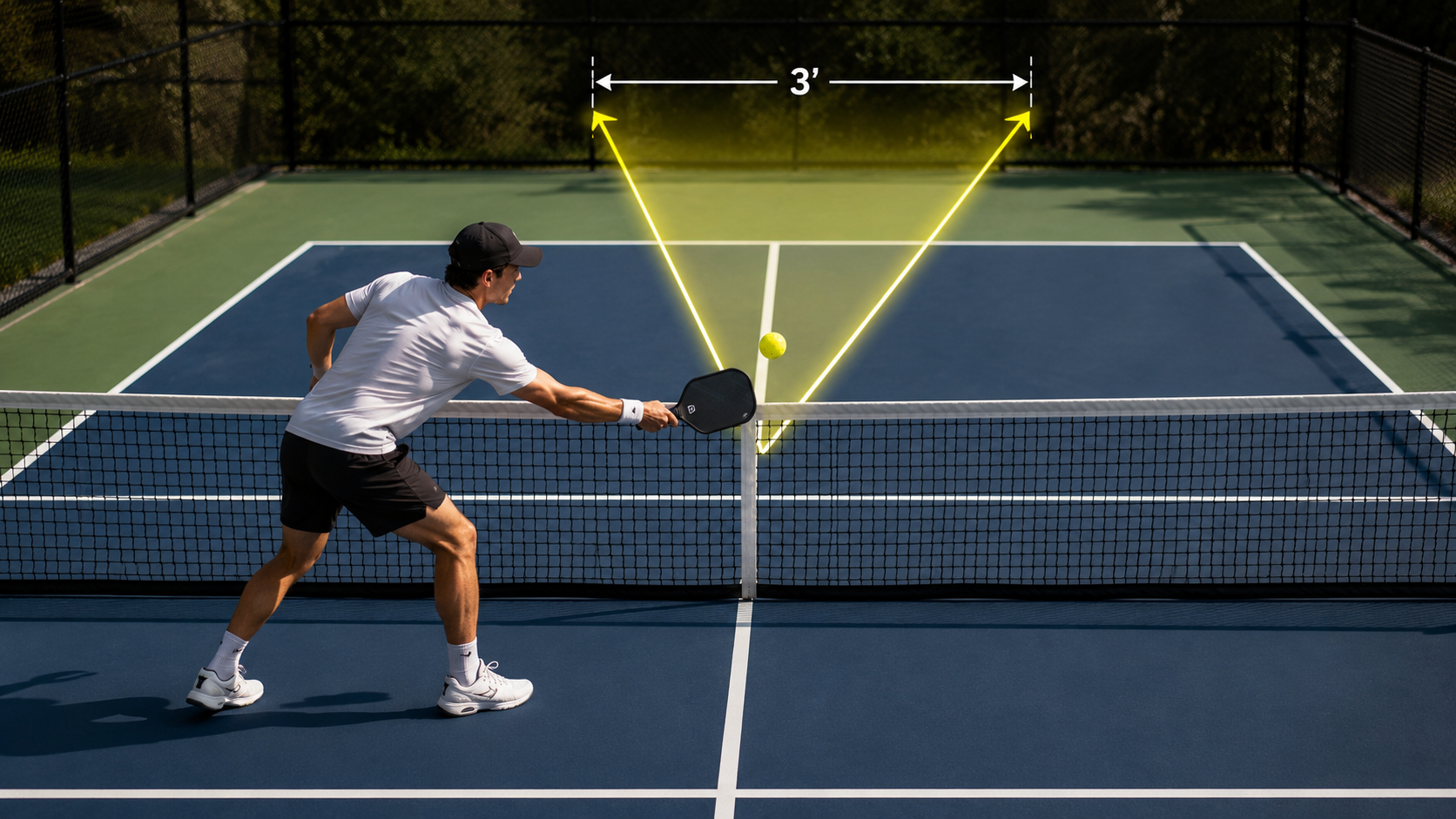
After you speed up the ball at the kitchen, one of two things happens: your opponent either goes down-the-line (the V angle) or goes cross-court. Most players watch the ball. Elite players watch the V — the angle created by the opponent's paddle face and body position at the moment of contact.
The V tells you where the ball is going before it leaves the paddle. A paddle face opening cross-court, weight shifting left — cross-court return coming. A paddle face cutting down-the-line, shoulder turning — line return. Reading the V means you are already moving before the ball arrives. That is not reaction. That is prediction.
This is a trainable skill. Start by watching the opponent's dominant shoulder, not the ball, for an entire point. The information is there every time.
The Transition Zone
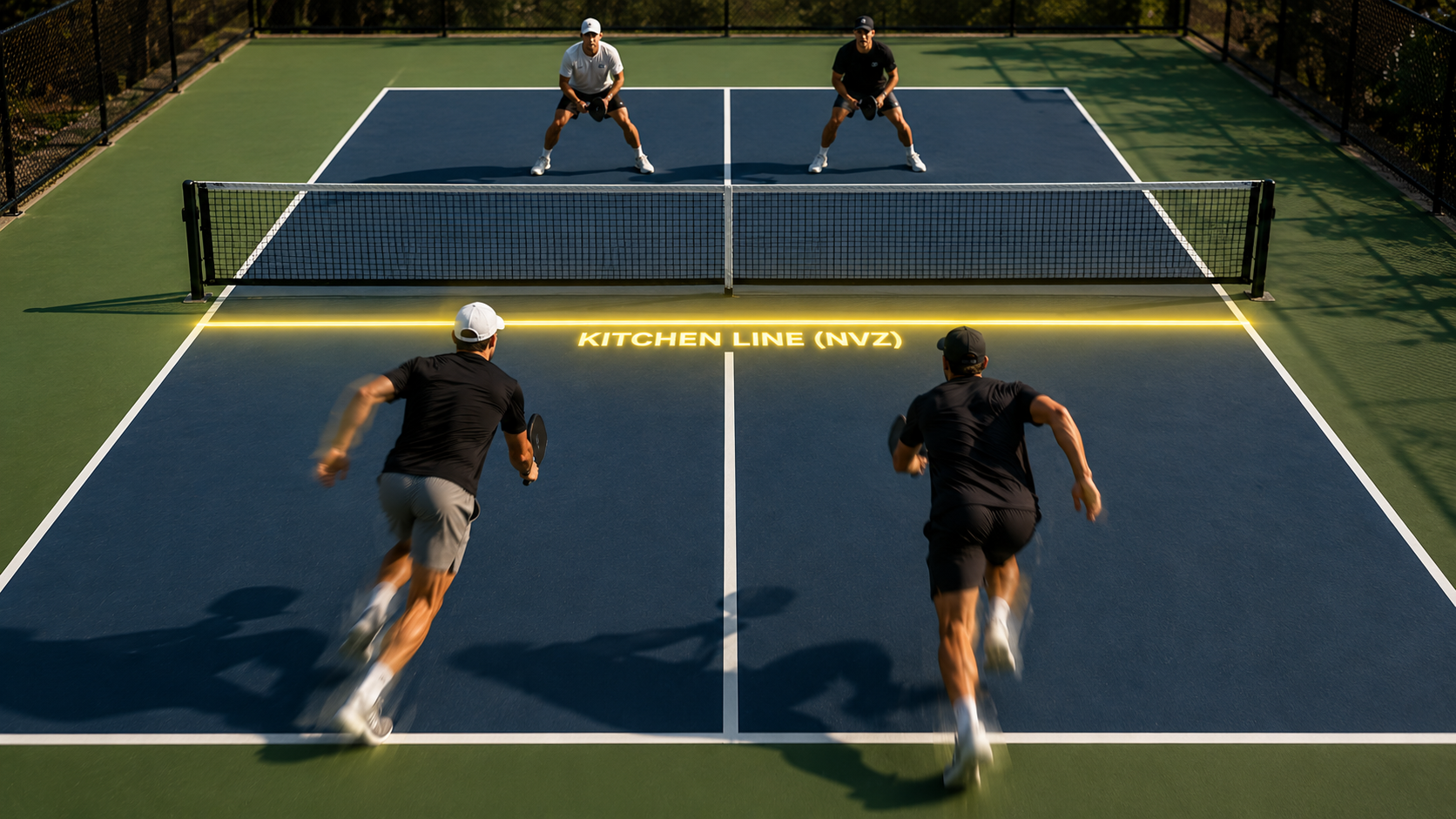
The transition zone — the area between the baseline and the kitchen — is the most dangerous place on the court. Balls arrive at awkward heights, your movement is compromised, and you are vulnerable to both pace and drops. The goal is to spend as little time there as possible.
There is one sprint in most pickleball points: the transition run from the baseline to the NVZ after a successful return or third-shot drop. That run is committed, decisive, and ends in a controlled stop at the kitchen line. Avoid hitting balls from the transition zone whenever possible. The goal is to get through it as quickly as possible, not to play from it.
The third-shot drop exists precisely to solve this problem. A soft ball landing in the kitchen gives the serving team the time needed to complete the transition run and arrive at the high ground.
The Rope — Two Players, One Unit
All the individual skills in doubles — the Traffic Light, the Donut, the V, the reset — exist within a partner system. Two players who execute individually but move independently will lose to two players with lesser individual skills who move as one unit.
Imagine a rope connecting both players at the hip. If one player moves three feet right, the rope pulls the other three feet right. There is never a gap in the middle. There is never an island on the far sideline. The pair moves together — not by command, but because both players have internalized the principle and watch each other as much as they watch the ball.
When the ball goes wide, both players shift toward it — not just the near player, a full bilateral shift that closes the middle gap. A team that half-shifts leaves the middle seam open — the highest-percentage target in doubles. A team that fully shifts presents a compressed defensive front.
Targeting — 11 Windows
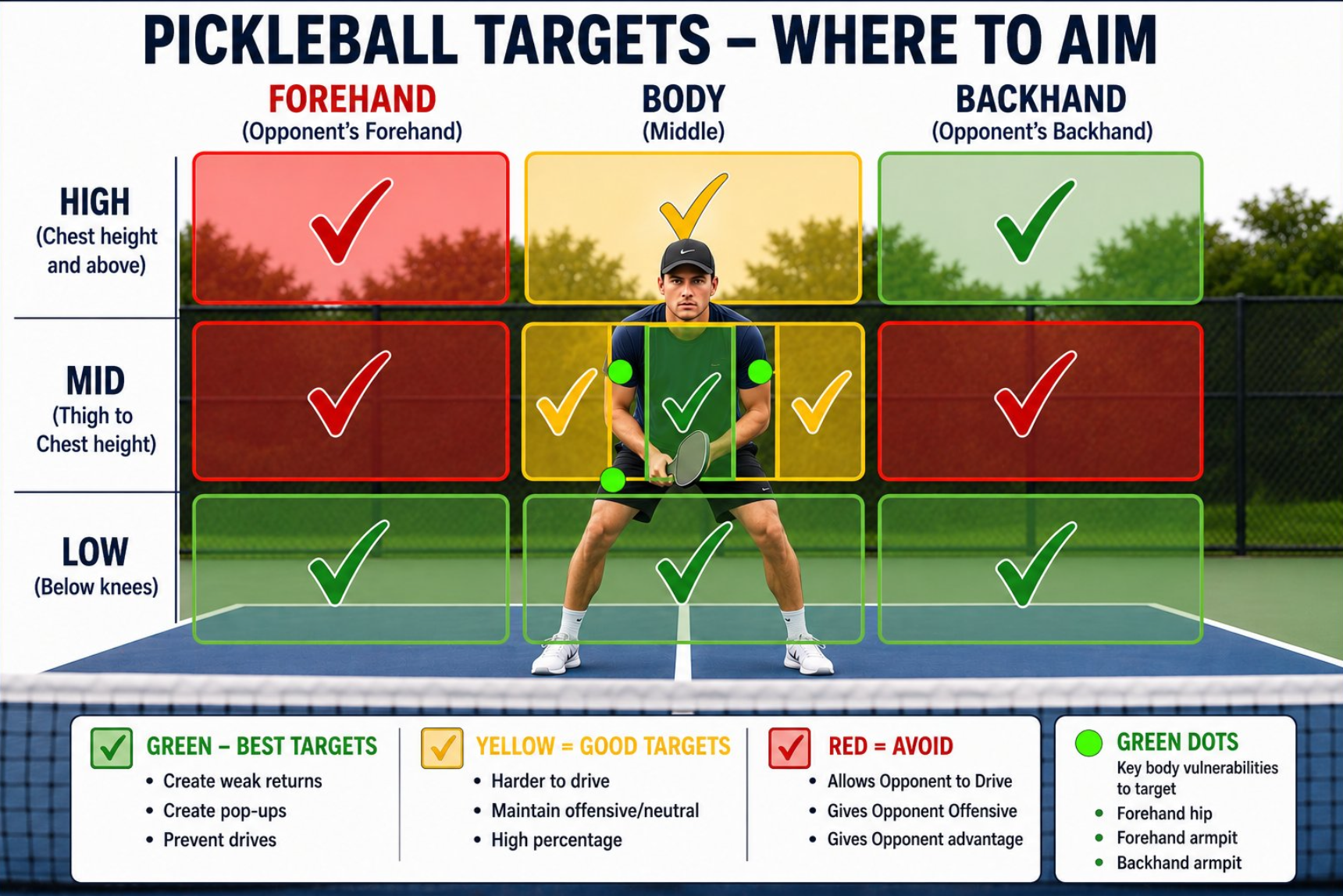
Every ball you hit is aimed at one of eleven targeting windows — specific areas of the opponent's court and body that create the maximum strategic pressure. Random placement, even when well-executed, surrenders the targeting advantage that intentional play creates.
The highest-percentage targets in doubles are: the middle seam between opponents (creates communication confusion), the backhand hip of the weaker player (forces awkward contact), and the feet of a transitioning player (prevents the kitchen arrival). These three alone, applied consistently, create far more opportunities than pace alone.
The Third Shot Decision Tree
The third shot — the serving team's first shot after the return — is the most strategically important shot in doubles pickleball. It determines whether the serving team can advance to the kitchen or remains pinned at the baseline.
The decision between a third-shot drop and a third-shot drive is not random. It follows a decision tree:
- Drop when: You are out of position, the return was deep, or you need time to get to the kitchen. The drop buys you transition time.
- Drive when: The return is short, you have a clean contact opportunity, or you want to test opponent reactions. The drive creates an easier fifth shot if it pushes opponents back.
- The key rule: A third-shot drive that creates an easier fifth shot is not a mistake. A third-shot drop that stops in the kitchen and gives you time to advance is always correct.
The Communication Layer
Two players who cannot communicate on the court are playing two separate singles matches that happen to share a side. The communication layer transforms individual execution into partnership strategy.
Effective doubles communication is brief, specific, and happens before the point — not during it. Call the ball ("mine" / "yours") before contact, not after. Signal the switch before you switch, not after the gap appears. Debrief between points, not mid-rally.
Pre-point communication is the most underused tool in recreational doubles: "Their backhand cross-court is floating. I'll take the middle." Three seconds before a point. It costs nothing and resets shared strategy from live information.
Opponent Profiling
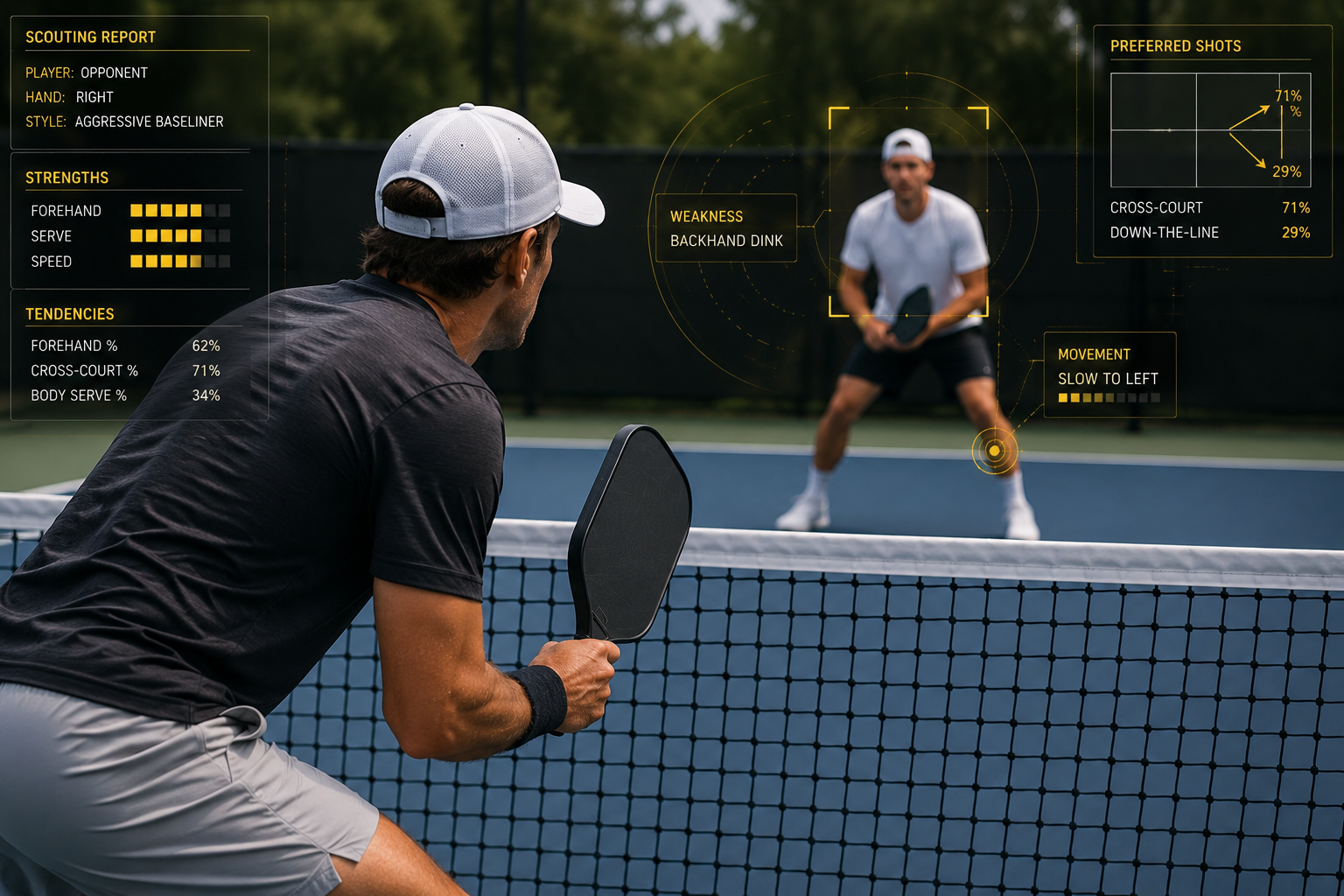
Every match reveals tendencies. The aware player finds them within the first three points and begins exploiting them by the fifth. Opponent profiling is not scouting — it is active observation during play.
Key things to profile immediately: Which player has the weaker backhand? Who moves slowly to their left? Does either player panic at pace? Is either player consistently late on speed-ups? Once a pattern is identified, target it relentlessly. Consistent pressure on a known weakness is not unsportsmanlike. It is correct doubles strategy.
Mental Tempo — The Thermostat
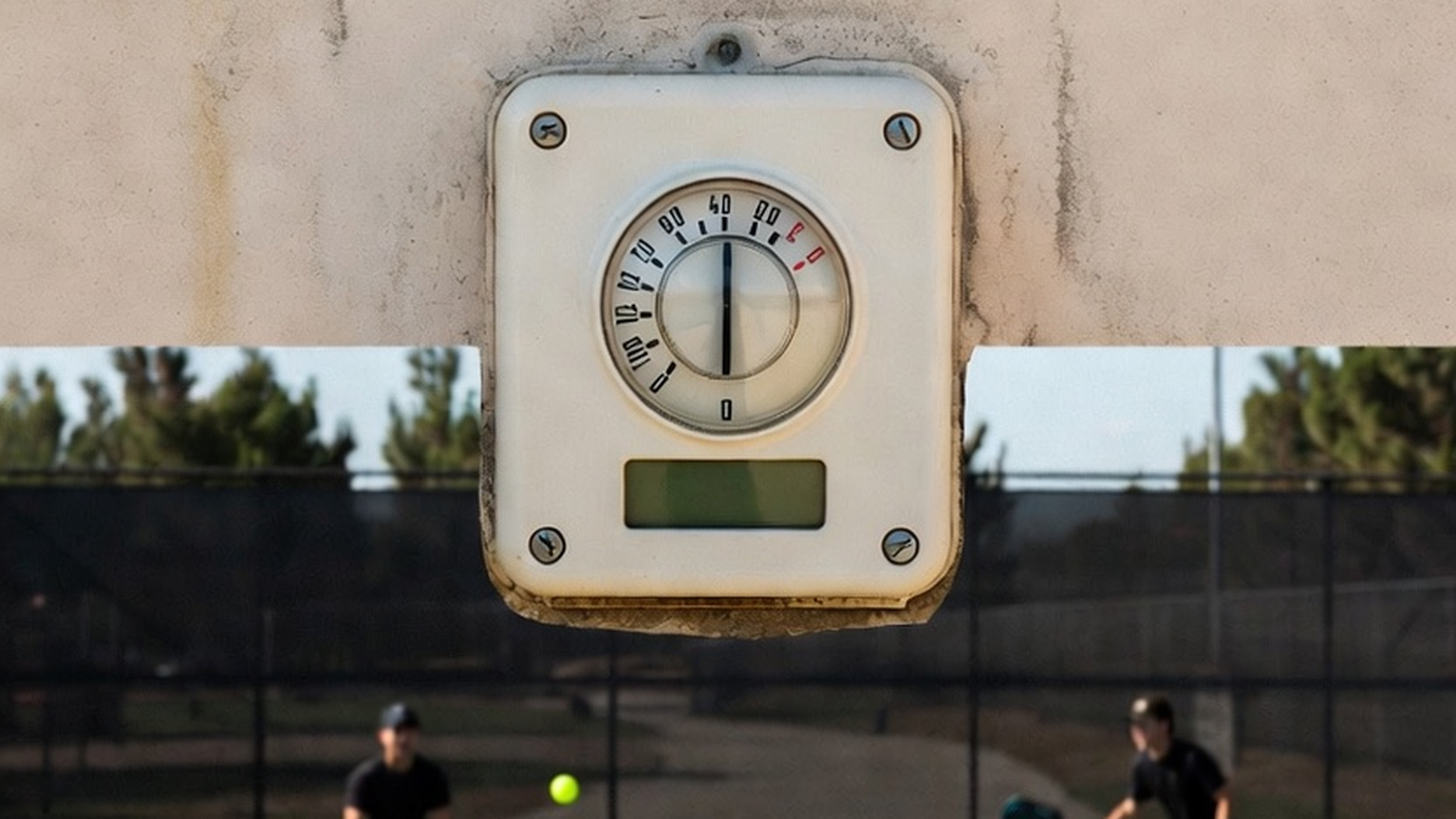
The final session in the Foundation addresses something no technique can fix: the mental state you bring to each point. Every player has a natural emotional temperature. Great competitors are thermostats — they set the temperature in the match and hold it steady regardless of what opponents do.
When you lose three points in a row, the thermostat player does not tighten or rush. They reset to their temperature and play the next point. When they go on a run, they do not get careless. They hold the temperature. Being the thermostat — not the thermometer — is what separates competitive players from reactive ones.
The 13 Foundation Sessions
All thirteen sessions are covered in depth in the free playbook. Here is the complete list:
-
01
The Power EquationWhy pickleball throttles pace — and how the design of the game determines the strategy.
-
02
The Kitchen Is the High GroundPositional ownership as the foundation of all doubles strategy.
-
03
Own the DonutMovement vocabulary for a compressed court.
-
04
The Dink — Offense with PatienceWhy the soft game is the primary offensive weapon.
-
05
The Traffic LightContact-height decision rules for attacking, pressuring, and resetting.
-
06
The VHow to read the return before the ball leaves the paddle.
-
07
The Transition ZoneHow to move from baseline to kitchen — and why it's one sprint, not a stroll.
-
08
The Rope — Two Players, One UnitThe partner movement system that connects all individual skills.
-
09
Targeting — 11 WindowsThe specific targets that create maximum strategic pressure.
-
10
The Third Shot Decision TreeDrop or drive — the decision framework that changes with every point.
-
11
The Communication LayerPre-point, mid-point, and between-point communication that transforms partners into a unit.
-
12
Opponent ProfilingHow to find tendencies, name them, and exploit them with intention.
-
13
Mental Tempo — The ThermostatHow to set the temperature in the match and hold it steady under pressure.
Frequently Asked
Get the Complete System
Every session, every pattern, every principle — in one free 87-page playbook.